Technology·
Trump-Xi Summit: Nuclear Shadow Looms Amid China's Buildup
As President Donald Trump and President Xi Jinping prepare to convene this week, a critical issue – China's rapidly expanding nuclear arsenal – may not headline their talks. Analysts warn this omission could destabilize global security as Beijing modernizes its atomic capabilities without international oversight.
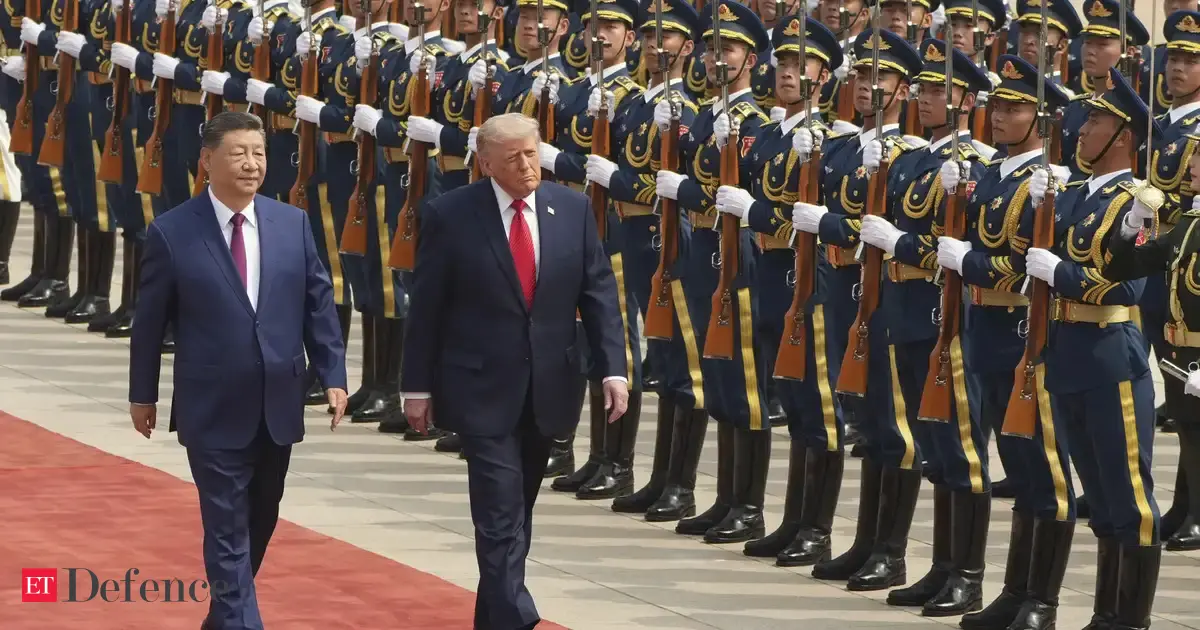
As President Donald Trump and President Xi Jinping prepare to convene this week, the world watches for signals on trade, Taiwan, and technological competition. Yet, beneath the diplomatic dance, a far graver concern — China's accelerating nuclear weapons program — seems poised to remain largely undiscussed, a dangerous oversight according to a growing chorus of analysts.
For decades, China maintained a relatively small, 'minimal deterrence' nuclear force, estimated in the low hundreds of warheads. That era is over. Recent intelligence suggests Beijing is dramatically expanding its arsenal, constructing hundreds of new missile silos and developing advanced delivery systems. We're talking about a significant shift, not just in quantity but in the sophistication of their capabilities. This isn't just about having more weapons; it's about building a force that can withstand a first strike and deliver a devastating counter-attack, moving China closer to the strategic posture of the United States and Russia.
China's Expanding Arsenal: A New Era
The scale of China's nuclear modernization has caught many off guard. While the exact numbers remain shrouded in secrecy, satellite imagery and defense reports point to a rapid expansion of missile fields in western China, specifically in regions like Xinjiang and Gansu. These aren't empty holes; they're designed to house intercontinental ballistic missiles (ICBMs) capable of reaching targets across the globe. This aggressive buildup challenges the established two-power nuclear dynamic that has largely defined global security since the Cold War. It's a move away from the minimal deterrence doctrine China historically adhered to, signaling a new, more assertive strategic stance.
The US has long called for China to join arms control talks, but Beijing has consistently refused, citing its smaller arsenal compared to Washington and Moscow. With China's force nearing parity with, or even potentially surpassing, the US in certain metrics, that argument rings hollow for many in Washington. The lack of transparency from Beijing only adds to the concern, making it harder for other nations to assess intentions and preventing any meaningful dialogue on strategic stability.
A Diplomatic Blind Spot?
So why might this critical issue get sidelined during a high-stakes summit like the one between Trump and Xi? The diplomatic plate is already full. Trade disputes, regional tensions over Taiwan, and competition in AI and semiconductors are all vying for top billing. It's easy for the long-term, existential threat of nuclear weapons to be overshadowed by more immediate, tangible economic or geopolitical squabbles. Furthermore, bringing up nuclear arms control directly with Xi could be seen as confrontational, potentially derailing other diplomatic goals Trump might prioritize.
Remember the Cold War, when the US and Soviet Union hammered out treaties like START to manage their nuclear stockpiles? That framework, imperfect as it was, provided a degree of predictability. No such architecture exists with China, and the prospect of a new, unregulated nuclear arms race involving three major powers – the US, Russia, and China – is deeply unsettling. The collapse of the Intermediate-Range Nuclear Forces (INF) Treaty in 2019, which once limited US and Russian missiles, underscores the fragility of existing arms control efforts and highlights the urgent need for new frameworks that include all major nuclear players.
The Stakes of Silence
Ignoring the elephant in the room won't make it disappear. Without open dialogue and some level of transparency, the risk of miscalculation grows. Accidental escalation, driven by incomplete information or misread intentions, becomes a more plausible scenario. This isn't just about the US and China; it reverberates globally, potentially prompting other nations to rethink their own nuclear postures or pursue their own weapons programs, further destabilizing an already tense international environment. Think about countries like Japan or South Korea, who rely on the US nuclear umbrella, watching China's unchecked expansion.
Ultimately, a proper Trump-Xi summit, one truly focused on global stability, would tackle the nuclear question head-on. If it doesn't, we're left with an increasingly opaque and dangerous strategic landscape, where the tools of ultimate destruction are multiplying without any agreed-upon guardrails. That's a future none of us can afford. The stakes are simply too high to let this critical conversation slide off the agenda.
- nuclear weapons
- china
- us foreign policy
- arms control
- xi jinping
- donald trump
Sources
- A proper Trump-Xi summit would deal with nukes · SECTIONS A proper Trump-Xi summit would deal; Bloomberg
Related
Two Critical Kernel Bugs Threaten Linux Systems
Two new "very critical" vulnerabilities, CVE-2026-64564 and CVE-2026-64561, have been reported in the Linux kernel, affecting multiple versions up to 7.2-rc4. These bugs, one in SCTP and another in KVM, present significant risks to systems running the widely used operating system.
Aug 4, 2026
Bouncy Castle Bug Poses DoS Risk for Java Systems
A recently disclosed vulnerability, CVE-2026-58059, affects the widely used Bouncy Castle cryptographic library for Java. The bug, involving quadratic-time processing of X.500 distinguished names, could lead to denial-of-service attacks. Developers are urged to update to patched versions immediately.
Aug 3, 2026
Netty DNS Poisoning: A Recurring Threat to Network Apps
A new vulnerability, CVE-2026-45674, has surfaced in Netty, a widely used network application framework. The flaw allows for DNS cache poisoning due to improper validation of CNAME records, potentially redirecting users to malicious sites. Developers should update to versions 4.1.135.Final or 4.2.15.Final immediately.
Jun 12, 2026