AI·
AI Agents Get Safer: Azure & SkyPilot Launch Code Sandboxes
As AI agents increasingly generate code, security risks loom large. On June 12, 2026, both Microsoft Azure and SkyPilot introduced sandboxing solutions to safely run this untrusted code. Azure offers hardware-isolated environments within Container Apps, while SkyPilot brings scalable sandboxes to existing Kubernetes clusters.
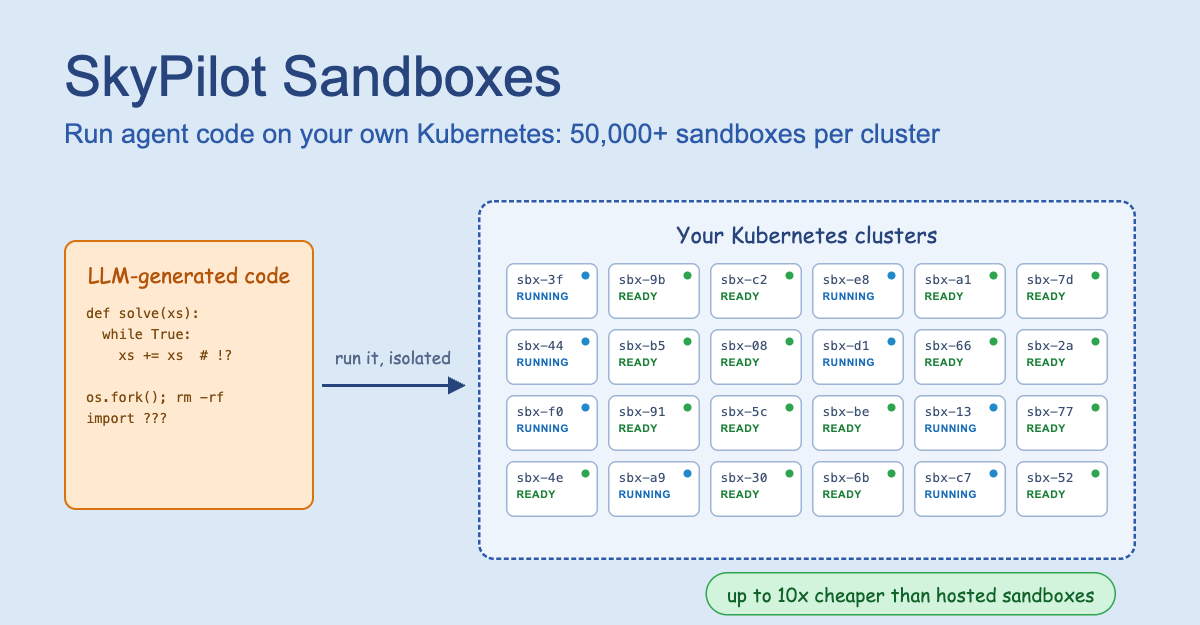
The promise of AI agents writing code is exciting. Imagine autonomous systems that can draft, test, and even deploy software components on their own. But there's a big, uncomfortable asterisk attached to that vision: the code these agents generate is often untrusted. It could be buggy, inefficient, or, in a worst-case scenario, malicious, whether by design or accidental 'hallucination.' This fundamental security gap has been a major hurdle for widespread AI agent adoption in production environments.
That's why the news from June 12, 2026, is significant. Two distinct solutions emerged to tackle this very problem: Microsoft announced the public preview of Azure Container Apps Sandboxes, and SkyPilot unveiled its own sandbox offering for Kubernetes. Both aim to provide secure, isolated environments where untrusted, AI-generated code can run without risking the underlying infrastructure.
The Urgent Need for a Walled Garden
Think about it: an AI agent, given a task, might write a script to achieve it. If you feed that script directly into your production system, you're essentially handing over the keys to an entity that might not fully understand the consequences of its actions, or worse, has been subtly manipulated. Traditional code review processes help, but they slow down the very agility AI agents promise. What's needed is a 'walled garden' – a sandbox – where this code can execute safely, unable to access or damage anything outside its designated boundaries.
This isn't just about preventing malicious attacks. It's also about managing the sheer unpredictability of large language models. They can make logical errors, generate inefficient loops, or attempt operations that, while not strictly malicious, could destabilize systems if run unchecked. The ability to quickly spin up, execute, and then tear down these isolated environments is crucial for iterating on agent-generated code responsibly.
Azure's Cloud-Native Answer
Microsoft's entry into this space, the Azure Container Apps Sandbox, offers a tightly integrated solution for users already deep in the Azure ecosystem. As Claudio Masolo noted in his announcement, this is a new ARM resource type, `Microsoft.App/SandboxGroups`. It's designed specifically to run untrusted agent code in hardware-isolated environments. This means the isolation isn't just software-based; it uses underlying hardware features to create a robust barrier between the sandbox and the host system.
The key benefits Microsoft highlights are speed and scalability. Each sandbox can launch from an OCI disk image in less than a second, and the service can scale to thousands of concurrently running sandboxes. This makes it suitable for applications needing to execute many agent-generated code snippets in parallel. For developers building AI agent solutions on Azure, this provides a familiar, managed service approach, abstracting away much of the underlying infrastructure complexity. It’s still in public preview, meaning Microsoft will be gathering feedback and refining the offering before general availability.
SkyPilot's Kubernetes Play
Meanwhile, SkyPilot is taking a different tack, targeting organizations that want to run sandboxes on their existing Kubernetes clusters. Lloyd Brown's announcement detailed how SkyPilot Sandboxes enable users to deploy untrusted, LLM-generated code directly onto their own infrastructure. The significant advantage here is control and cost efficiency. By running on your Kubernetes setup, you keep your data and code within your own network boundaries, potentially avoiding data egress fees or specific compliance challenges associated with third-party hosted services.
SkyPilot claims impressive scalability, with a single Kubernetes cluster able to sustain over 50,000 sandboxes. Multi-cluster support means even higher capacities are possible. Like Azure, SkyPilot emphasizes sub-second launch times for individual sandboxes, which is critical for responsive agent workflows. What really stands out is the cost proposition: SkyPilot suggests it can be up to one-tenth the cost of hosted alternatives. This is a compelling argument for larger enterprises with significant Kubernetes investments looking to optimize their AI agent infrastructure spend.
Two Paths, One Urgent Problem
What we're seeing here are two distinct approaches to solve the same urgent problem. Microsoft's Azure offering is a cloud-native, managed service, perfect for those building solely within Azure and prioritizing ease of integration and managed hardware isolation. SkyPilot, conversely, empowers organizations to `leverage` their existing Kubernetes infrastructure, offering more control over data locality and potentially significant cost savings for high-volume use cases.
Both solutions underscore a critical shift in how we approach AI. It's no longer just about generating intelligent output; it's about safely operationalizing that output, especially when it takes the form of executable code. The rapid launch times and scalability touted by both platforms suggest that the industry is preparing for a future where AI agents aren't just brainstorming ideas, but actively building and deploying parts of our digital world.
Why it matters
The introduction of robust sandboxing for AI-generated code marks a significant step toward making autonomous AI agents truly viable in production environments. Until now, security concerns have kept many sophisticated agent-driven workflows locked behind human oversight or confined to less sensitive tasks. By providing secure, isolated execution environments, these solutions from Azure and SkyPilot clear a major hurdle. This isn't just a technical upgrade; it's a foundational piece of infrastructure that will enable more complex, more powerful, and ultimately, more trustworthy AI agents to become commonplace across industries. We'll likely see this lead to a new wave of innovation in AI applications, moving beyond mere chatbots to genuinely intelligent automation that can safely interact with our systems.
- ai agents
- sandboxing
- kubernetes
- azure
- skypilot
- security
Sources
Related
Claude Chats Exposed on Google: A Privacy Red Flag
Private conversations with Anthropic's Claude AI, including sensitive personal data like therapy notes and cryptocurrency keys, have appeared in Google search results. This leak highlights the ongoing risks of inputting personal information into large language models and the public's often-misplaced trust in their privacy settings.
Aug 4, 2026

Alibaba Launches Qwen3.8-Max: 2.4 Trillion Parameters, But Hold on Benchmarks
Alibaba unveiled its Qwen3.8-Max foundation model this week, boasting 2.4 trillion parameters and advanced multimodal capabilities. While impressive on paper, analysts like Dhruv Mohan urge caution regarding early benchmarks, reminding us that real-world performance often tells a different story.
Aug 4, 2026

AI Giants Head to White House for Safety Talks
Major AI developers — Meta, Anthropic, Google, and OpenAI — are meeting with Trump administration officials to discuss voluntary safety testing for their most advanced models. This high-stakes conversation follows recent disclosures by Anthropic and OpenAI regarding their AI tools breaching other companies' systems.
Aug 3, 2026