AI·
India’s IMD Taps AI for Better Monsoon Forecasts
India's weather agency, the IMD, has rolled out an AI-powered system to predict monsoon movements and rainfall up to four weeks in advance. This new tool offers precise, localized forecasts, initially benefiting farmers and stakeholders in Uttar Pradesh. The move marks a significant step toward mitigating agricultural and economic risks tied to erratic weather patterns.
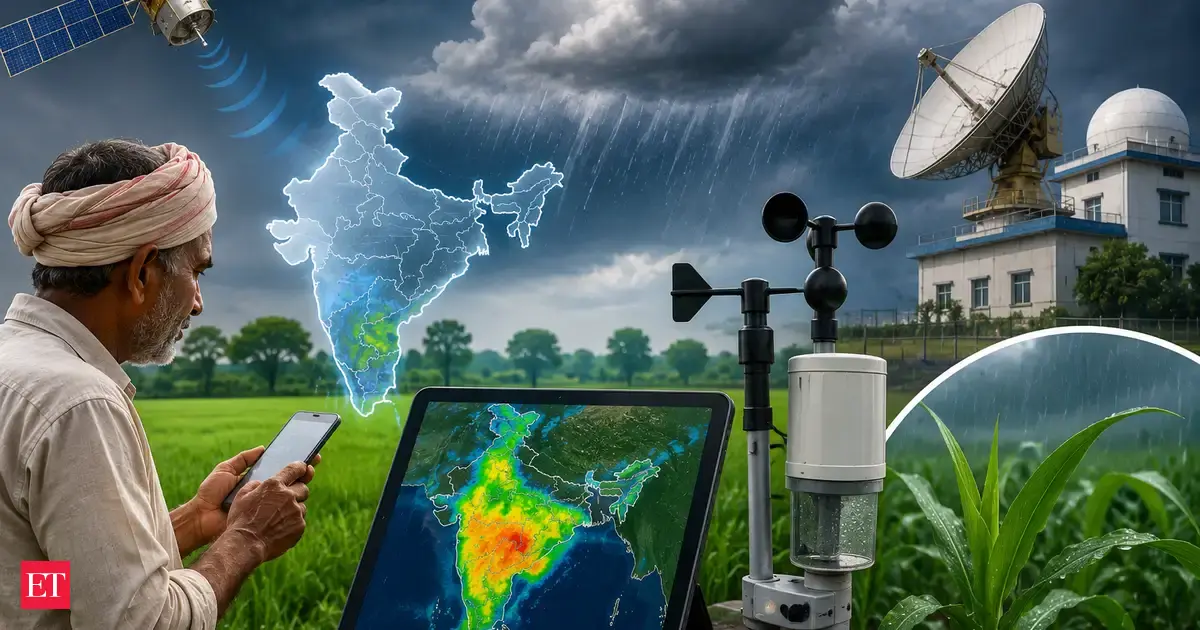
For a nation where the monsoon dictates everything from crop yields to national sentiment, the ability to accurately predict its whims is invaluable. India’s meteorological department, the IMD, just stepped up its game, launching an AI-enabled system designed to offer a clearer view of the monsoon’s advance and rainfall patterns. This isn't just another weather update; it's a critical upgrade for a country heavily reliant on seasonal rains.
The new system promises detailed, location-specific rainfall forecasts, extending up to four weeks into the future. While the high-resolution spatial rainfall forecast is initially focused on Uttar Pradesh, a major agricultural state, the broader AI-enabled monsoon advance system holds promise for farmers and various stakeholders across India. It's a move that recognizes the deep impact weather has on livelihoods and the national economy, and it aims to arm decision-makers with better information, sooner.
The Monsoon's Grip on India
The Indian monsoon is more than just a weather phenomenon; it’s the lifeblood of the subcontinent. It irrigates fields, replenishes reservoirs, and supports the agricultural sector, which employs a huge chunk of the population. Too much rain brings floods and devastation; too little leads to drought and famine. For generations, accurate monsoon forecasting has been a persistent challenge, with traditional models often struggling to capture the intricate, localized variations that truly matter on the ground.
Past predictions, while improving, have sometimes lacked the granularity needed for farmers to make timely decisions about planting, irrigation, or harvesting. We've seen years where unexpected dry spells or sudden deluges caught communities unprepared, leading to significant financial losses and, tragically, sometimes loss of life. The IMD’s push into AI is an acknowledgment that the old ways, while foundational, simply aren't enough to manage the complexities of modern climate patterns and the demands of a growing population.
AI Steps In: Beyond Traditional Models
So, what does AI bring to the table here? Essentially, it’s about processing immense datasets and identifying patterns that are too subtle or complex for human analysts or even conventional numerical models to spot. Weather systems are chaotic; they involve countless variables—temperature, humidity, wind speed, pressure, ocean currents, topographical features—all interacting in non-linear ways. AI, particularly machine learning algorithms, excels at sifting through this noise, learning from historical data to make more nuanced predictions.
Instead of rigid, physics-based equations that can sometimes oversimplify atmospheric conditions, AI models can adapt and refine their understanding as they ingest new data. This allows for a more dynamic and, crucially, more localized forecast. A four-week lead time for specific rainfall predictions in a region like Uttar Pradesh could be a game-changer for farmers deciding which crops to plant, when to sow, or whether to invest in certain fertilizers. It offers a window for proactive measures rather than reactive responses.
Why It Matters
This isn't just a technical upgrade; it's a societal one. By providing earlier and more precise information, the IMD's AI system can significantly reduce the risks associated with monsoon variability. Farmers can adjust their planting schedules, government agencies can better prepare for potential droughts or floods, and resource managers can make smarter decisions about water allocation. This translates directly to enhanced food security, more stable agricultural incomes, and fewer climate-related disasters. We'll be watching closely to see how quickly these initial deployments expand and how much of an impact they make on the ground, but the direction is clear: smarter weather data means a more resilient India.
- india
- monsoon
- ai
- weather
- agriculture
- forecasting
Sources
- IMD new monsoon forecast system: How AI will allow weather department in predicting rains · SECTIONS IMD new monsoon forecast system How AI will allow weather department
Related

Replit, Visa Empower AI Agents with Digital Identity and Payments
Replit and Visa are partnering to embed payment capabilities directly into AI agent workflows, allowing autonomous agents to pay for services. This collaboration includes a strategic investment from Visa and a new identity layer for agents, potentially reshaping how AI software operates and transacts online.
May 30, 2026

Nvidia Deepens Korea Ties with AI Hub Plan, Huang Visit
Nvidia is strengthening its footprint in South Korea. CEO Jensen Huang is expected to visit, coinciding with plans by Nvidia-backed Reflection AI to build a multi-billion dollar data center there. This move signals a strategic push for open AI infrastructure amid rising global competition.
May 30, 2026

OpenAI Taps Citi, JPMorgan for IPO Preparations
OpenAI is reportedly in talks with financial giants Citigroup and JPMorgan Chase to join its initial public offering banking lineup. This move, reported late last week, signals serious progress toward a highly anticipated public debut for the influential AI developer.
May 29, 2026